


On July 1, the Workplace Flex Fund made its first loans available to employees of Fillmore Linen Service in North Lawndale, with Great Lakes Credit Union serving as the inaugural lending partner. Why would a local credit union and laundry on the West Side offer workers affordable small loans? The answer begins with a credit market that is quietly splitting in two.
A Market Pulling Apart
In April, TransUnion released its Q1 2026 Credit Industry Insights Report with a stark headline: The American consumer credit market is splitting in two. Super prime borrowers have grown by roughly 15 million consumers since 2019 and now make up more than 40 percent of credit-active Americans. At the other end of the “K,” the subprime share is growing, while the middle tiers shrink.
The K-shaped credit market
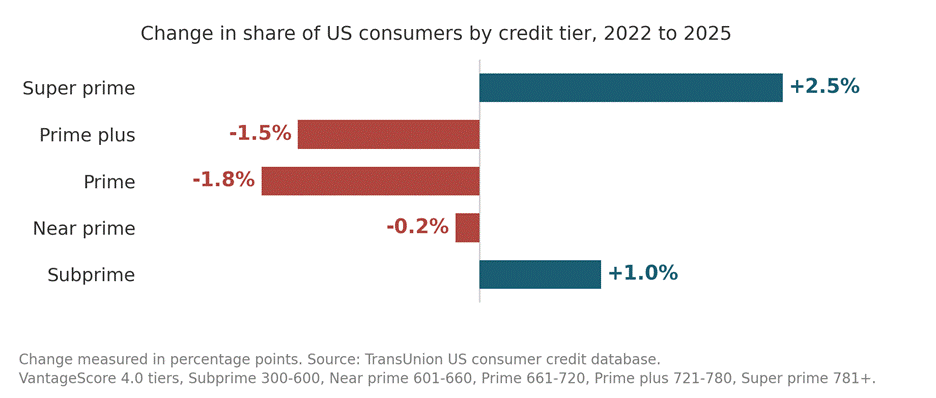
This is not a story of reckless borrowing. TransUnion’s data show that among non-prime households, expense growth has outpaced income growth, and the families with the least cushion are absorbing the most pressure. The Federal Reserve’s Survey of Household Economics and Decisionmaking found that 37 percent of American adults cannot cover an unexpected $400 expense, and that 59 percent faced at least one major unexpected expense, such as a car repair, in the prior year. In Chicago, that fragility means hundreds of thousands of residents may face a gap between an unexpected bill and affordable credit to cover it.
Employers feel the pressure, too. PwC’s Employee Financial Wellness Survey found that financially stressed workers spend more than three hours each week on personal financial concerns while at work, and a MetLife study found financially stressed employees are twice as likely to miss work. Financial fragility is not just a consumer problem. It is an employer problem.
Demand Doubled. Affordable Options Didn’t.
TransUnion data show that originations of small-dollar loans (loans of less than $1,500) more than doubled in the Chicago market between the end of 2022 and the end of 2024, from roughly 5,900 consumers to 13,500. But banks and credit unions, which offer the most competitive rates, account for only about 27 percent of those originations. The other 73 percent come from higher-cost channels. Illinois’ Predatory Loan Prevention Act rightly pushed payday lenders out of the state in 2021, and many non-bank lenders pulled back from subprime borrowers after pandemic-era delinquencies. The result was that demand for emergency credit doubled while the supply of affordable ways to meet it thinned.
A Coalition to Create a Solution
To address this need, TransUnion, the Woodstock Institute, and the Corporate Coalition of Chicago decided to look for a solution. Armed with TransUnion data, and informed by New America Chicago and ChicagoSpeaks survey data, the team studied models from around the country, including Income Advance program, an employer-sponsored small-dollar loans product developed by Rhino Foods in Vermont. Rhino launched Income Advance in 2007 and has spread the model to other employers and lenders across the country. In 2024 alone, the program provided $2.26 million in loans to 1,656 workers across 111 businesses.
Building on this model, we created the Workplace Flex Fund (WFF). To participate in WFF, lenders agrees to the following terms:
• Loans of $1,000 to $2,000, extended based solely on employment status, with no credit check
• Funds disbursed within 24 hours
• An APR capped at 20 percent, roughly half the market rate for subprime borrowers
• Repayment through payroll deduction over six to twelve months
• Every payment reported to the credit bureaus
• The option to roll completed loan payments into emergency savings
Research from the Financial Health Network and the Social Policy Institute found repayment rates of 95 to 98 percent on these loans, with 95 percent of borrowers choosing to convert their payroll deduction into savings once the loan is repaid. Employers that offer the benefit report 20 percent lower turnover.
A Step, and a Demonstration
Which brings us back to Fillmore Linen and Great Lakes Credit Union. Somone needs to lead, and this is what Filmore and Great Lakes have done. The pilot is aiming for 60 loans in the first six months. The meaningful measure will be what accumulates: credit histories built, savings started, and eventual access to the auto loans and mortgages that turn income into wealth.
The Workplace Flex Fund will not, on its own, close the K catch every family with sudden cash needs. And like a safety net, it would be better not to need it in the first place. But it is a step, and it is a demonstration. When a credit bureau contributes its data, a policy organization contribute its expertise, others contribute survey data, employers contribute their payrolls and lenders offer a new, tailored product the market was not providing, good thing can happen. Not out of charity, but because thriving employees make thriving businesses and good customers for lenders. That is what the Workplace Flex Fund is doing today.