

Good news keeps coming from the labor market. The economy created 172,000 new jobs in May. March and April were revised upward by a combined 93,000 jobs. So far in 2026, monthly job creation averages 114,000.
But average hourly earnings have risen just 3.4% year-over-year, while inflation hovers around 4%. Americans are getting hired faster and paid less, in real terms.
When Work Doesn’t Pay
What happens when work doesn’t pay? For starters, people get grouchy. Consumer confidence hit its lowest mark on record in May according to the University of Michigan’s Index of Consumer Sentiment. People also stop working. May’s labor force participation rate, 61.8%, is more than 6 percentage points below its 2000 peak.

And people lose faith. In a 2025 Wall Street Journal/NORC poll, nearly 70% of adults said the American Dream — work hard, get ahead — no longer holds or never did. Only 21% expect a better life for their children.

Inequality vs. Precarity
Inequality often gets the blame for this malaise. Indeed, inequality it has reached levels unseen since before the Gilded Age — the top 1% now holds about 35% of all wealth. But some inequality is the price of a free society. Likely inequality itself is not the issue. Rather, the real problem is what life is like on the wrong side of median wage.
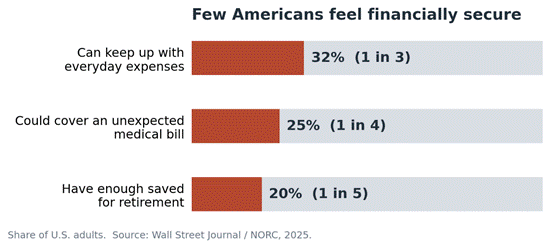
More than half of Americans worry about the price of groceries. Only one in three thinks they can keep up with everyday expenses. One in four could cover an unexpected medical bill. One in five believes they have enough saved for retirement.
Precarity is not just a problem of the lowest paid. A recent ChicagoSpeaks survey conducted by NORC at the University of Chicago survey found that 31% of working adults tapped their wages early in the past two years. And the need to access wages early actually ran highest among people earning $30,000 to $100,000, not the poorest. Half use emergency funds to cover basic needs.
Perhaps the New York Times captured best what it means to be one of these 70+ million Americans – more than half the workforce – who early less than $25 an hour: Disney theme parks, once icons of middle-class American childhood, have become prohibitively expensive for most families. Disney’s shift toward luxury experiences and tiered access has eroded the universal appeal of the park, making it a privilege for the few. Working Americans are left to explain to their children why a Disney vacation is out of the question.
Where business comes in
Government has a role. But gridlock in Washington has left people skeptical that the public sector will deliver. At the same time, private sector employers control about 90% of the jobs in most regions, which means business can move where government stalls. Business leaders can:
Expand benefits, such as healthcare, paid leave, and retirement security
Invest in training and advancement for every employee
Build dignified, supportive workplaces
Hire from overlooked populations and places, including veterans and justice-impacted residents.
Each step rebuilds faith that work pays, because each step helps make work pay. Members of the Corporate Coalition of Chicago are taking those steps. The opportunity to join them is open to everyone.