

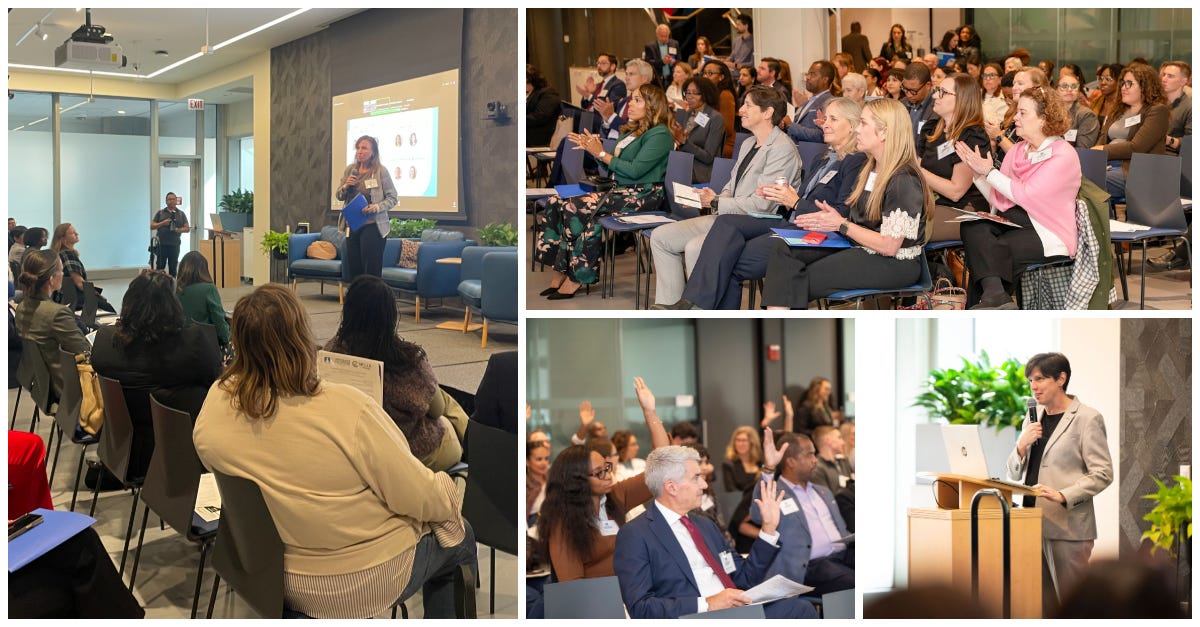
Last week, more than 110 members, partners, and guests gathered for the Corporate Coalition of Chicago’s 30th membership meeting. We set out in 2019 to change business practices in ways that would reduce longstanding economic and racial inequities. To create, “Business UNusual,” as we eventually talked about it. Back then, nobody knew COVID or George Floyd, and “AI” mostly referred to sci-fi movies.
Today, we have more than fifty member companies, six active initiatives, and a growing community. Some of what we’ve tried has worked. Some we’ve left behind. A few lessons stand out:
Doing the work is the work. We work alongside members to help change business practices. That work can be hard, slow, even unglamorous. But staying committed to creating a new culture of doing business, process by process, company by company, is the work we remain committed to. As a result, we have earned a reputation as the place where things get done.
The public expects more from business. For two years running, we have surveyed Chicagoans using NORC’s ChicagoSpeaks panel. We’ve learned that Chicago residents hold high expectations for local business but see low performance. They are split on whether they can trust business leaders to do the right thing. We see that as an opportunity to build trust with the business community, as the non-profit sector has done.
Executives remain committed, despite their silence. Many executives are less willing to speak publicly about our work today than in 2019. Yet membership is growing, in part because leaders of all types are hungry to work where success is about more than just maximizing financial return. Members also yearn for a community of like-minded colleagues, which we curate and grow.
New approaches require persistence, flexibility, and leaders willing to take risks. Just one example: Our team, partners, and members have been working since 2019 on a solution to investing equity capital in community-driven, catalytic real estate projects. After several iterations, we landed on E-CAP, an approach that attracted two lead investments from executives willing to take a risk. Those investments attracted the other needed investors, and today we have a clear path to closing.
The context has changed since 2019. But the need to rethink long-standing business practices so that companies, employees, and communities all succeed has only grown.
It is said that we often overestimate the impact we can have in a year and vastly underestimate what ten years of sustained commitment can accomplish. We are seven years in. We and our members will keep pushing, excited to see what sustained commitment can accomplish. I hope you will join us.